Free deposit-to-visit check

Healthcare QuickBooks cleanup? Match the deposit.

Four taps. One lump is not the week.

Forty visits. The bank shows one number.

Question 1 of 4

Which deposit will not tie?

Question 2 of 4

Which date holds the visit?

Question 3 of 4

What is the fee gap?

Question 4 of 4

Why is the bank quiet?

Your deposit-to-visit check can start. Where should we reach you?

    You will be talking to the Steven Palmieri practice.

    Next you pick a time for a free video call with the Steven Palmieri practice. Nothing to sign, nothing to pay.

    Prefer to read first? It's all below ↓

    Healthcare Business QuickBooks CleanupMatch the deposit to the visit

    The schedule was full and the bank was not, and both are true. Steven Palmieri, Tax CFO, clears that file with the owner.

    Plan deposits arrive in bundles, patients pay their part at the counter, and write-offs happen by accident. We clear the file so the bank, the claims and the write-offs tell one story, then close each month and prepare the return from it.

    The words healthcare business quickbooks cleanup, with a blinking cursor

    What the bank cannot match.

    Steven Palmieri, Tax CFO

    You will be talking to the Steven Palmieri practice.

    Ask about my books
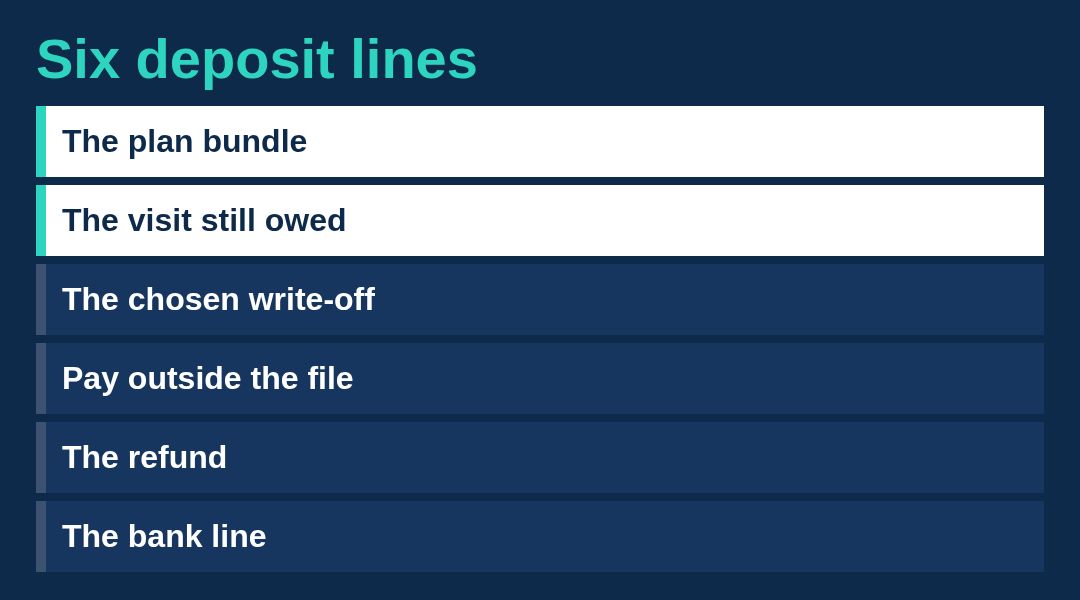
    Six deposit lines, each one lighting as it ties

    Open one deposit line

    Pick one deposit.

    Plan bundle

    One deposit can hide many visits.

    Open the bundle page.

    Patient refund

    Money sent back needs the old payment.

    Open the refund page.

    Still owed

    Care given can still be unpaid.

    Open the owed page.

    Owner draw

    Pay outside the file misses the close.

    Open the owner pay page.

    Chosen write-off

    The fee gap should be a choice.

    Open the write off page.

    Bank first

    Trust the month after the bank agrees.

    Name that month.

    All six deposits
    1. Plan bundle

      One deposit can hide many visits.

      Open the bundle page.

    2. Patient refund

      Money sent back needs the old payment.

      Open the refund page.

    3. Still owed

      Care given can still be unpaid.

      Open the owed page.

    4. Owner draw

      Pay outside the file misses the close.

      Open the owner pay page.

    5. Chosen write-off

      The fee gap should be a choice.

      Open the write off page.

    6. Bank first

      Trust the month after the bank agrees.

      Name that month.

    Open the unmatched deposit.

    Steven PalmieriSteven Palmieri, Tax CFO

    Steven Palmieri, Tax CFO.

    Steven Palmieri is the Entrepreneur's CFO. Steven and his team keep the clinic month and the federal return in one file, so a write-off chosen on the close is the write-off the return later reads.

    Which month should we open.

    Tell us the month a lender already asked for, and which deposit inside it still refuses to match the bank.

    Steven Palmieri, Tax CFO

    You will be talking to the Steven Palmieri practice.

    The month and the return.

    Steven and his team keep one file for the clinic month and the federal return, so the write-off stays on the line the return later reads. The close and the return are not two offices retelling the same week.

    Where each tile goes.

    A plan bundle, a patient card, and a write-off can share one afternoon. The bundle page opens the lump. The owed page keeps the visits the cash has not caught. The write off page keeps the gap. The owner pay page puts that pay on the same close. The refund page gives money sent back a home. The deposit is matched to the visit before anyone calls the month closed.

    Visit and the cash.

    You did the work on a Tuesday. The plan paid some of it weeks later. The patient paid a share at the counter, or did not. An adjustment came off because the allowed amount was less than the fee. If the only line in the file is the amount that hit the bank, you cannot see the work, the amount you will never collect, or what is still owed.

    The charge belongs in the month of the visit. The adjustment, the part you will not collect, belongs as its own line so it does not pretend to be a smaller charge. The cash belongs on the day it arrives, split between what the plan paid and what the patient paid. Those are different payers. One blended deposit hides a slow plan inside a busy week, and it hides a balance the counter could still collect.

    We reconcile the bank before we trust a revenue figure. A month that still disagrees with the bank is not the source of a number anyone should hand to a lender. The categories follow the way care is paid, not a generic list copied from a shop that sells goods.

    Where a refund goes.

    A patient who overpaid, or who paid and was then covered, gets money back. That refund does not belong among miscellaneous costs or as a made-up negative visit. It reduces what that patient had already paid. If the refund has no home, the next deposit will never tie, because you are comparing the bank to a story that skipped a chapter.

    We give the refund the patient's payment as its home, then we re-tie the bank. The relief on the other side of that tie is ordinary and large. The week stops feeling like the software is lying.

    Cash still not here.

    Credentialing and slow claims create a different quiet. The work is real. The cash is not here. That work is money still owed until it pays, or until you decide it will not. Leaving it out until the deposit arrives makes a credentialing delay look like a slow clinic. Putting it in as if it were already cash makes the bank impossible.

    The honest middle is a receivable. Work done, money not here, collected or written off later on purpose. A plain example. A run of visits went out. A deposit arrived that matches no single visit, because it is a bundle from a plan, net of an adjustment, plus payments from the counter. In a cleaned file the bundle is broken into the claims it paid, the adjustment is visible, and the patient payments sit on those patients. The deposit matches the bank. The visits the bundle did not cover are still sitting as owed, which is the list the counter actually needs.

    Pay in the same month.

    Splits, guarantees, and bonuses often live in a workbook while the books stay wrong. A draw is neither a mystery nor a personal errand. It is part of the month. When it stays outside the file, the profit of the clinic and the pay of the people who delivered the care tell two stories.

    Payroll, if the clinic has employees, can be set up on a provider the clinic then runs. We do not send the paydays. Once that provider is in place, the wages that belong in the compensation story have a real source. The draws and guarantees of owners are a different conversation, and they still have to land in the same close.

    A clearinghouse deposit leaves with the claim and comes back days or weeks later as one lump. The lump is a loop. The amount that returns is smaller than the fee that left, because an adjustment and a patient share have already come out. We match the deposit that came back to the claims it actually paid, and we leave the unpaid visits sitting as money still owed.

    What you send.

    Send the deposit detail from the plans, the list of what patients paid, and the bank feed. We work from those financial exports. A chart, a diagnosis, and a patient's name are not required for the cleanup, and they should not ride along in a note on this site.

    What you get back is a file where a deposit is not the only record of a visit, write-offs are chosen rather than accidental, and a refund has a name. You can then tell earned work from collected cash without holding a meeting about it.

    The price is named before the paid work starts, from the months the bank still disagrees and from the accounts in the file, not from a clock we invent on this page. The first conversation names the deposit that will not match. The cleanup is scheduled only after both sides have signed a scope that states the fee.

    Questions before a file.

    The plan's deposit matches no single visit. How should it be entered?

    As the bundle it actually is. Break it into the claims it paid and the adjustment it took. A lump in income hides both the write-off and the visits the deposit did not cover.

    A patient overpaid and money went back. Where does that refund go?

    Against that patient's payment. Not into a miscellaneous cost, and not into a fake negative visit. If the refund has no home, the next deposit will not tie to the bank.

    Work was done and credentialing is still pending. Is it income already in the bank?

    It is money still owed until it pays or until you decide it will not. Leaving it out makes the clinic look slow. Recording it as if it were already in the bank makes the bank a lie.

    Will the cleanup replace the person who signs the return?

    No. After the bank agrees, the federal return copies that month. A letter that needs an audit, a review, or a compilation goes to a firm that is allowed to sign that letter.

    Federal lines on this month.

    When the clinic pays another practice for care, that payment belongs on Form 1099-MISC, and medical and health care payments go in box 6. For payments made in 2026 the instructions put the threshold for certain information returns at 2,000 dollars. Backup withholding is reported no matter the size. Associate clinicians paid as nonemployees belong on the information return that matches how they were paid.

    If the clinic has employees, Form 941 is the quarterly employer return, and Form W-2 closes the year for those wages. We can put a payroll provider in place. After that handoff the clinic sends the pay. We do not run payday, and we do not invent a wage figure the payroll report does not already show.

    A clinician who still drives between rooms splits 2026 mileage in half. The rate is 72.5 cents a mile from 1 January through 30 June, and 76 cents a mile from 1 July through 31 December. Equipment placed in service in a tax year that begins in 2026 meets a Section 179 limit of 2,560,000 dollars, and that limit starts to phase out when the property placed in service goes past 4,090,000 dollars. A sport utility vehicle taken under that section cannot go past 32,000 dollars. Those figures belong on the federal return. They do not change which deposit failed to tie.


    What to read next.